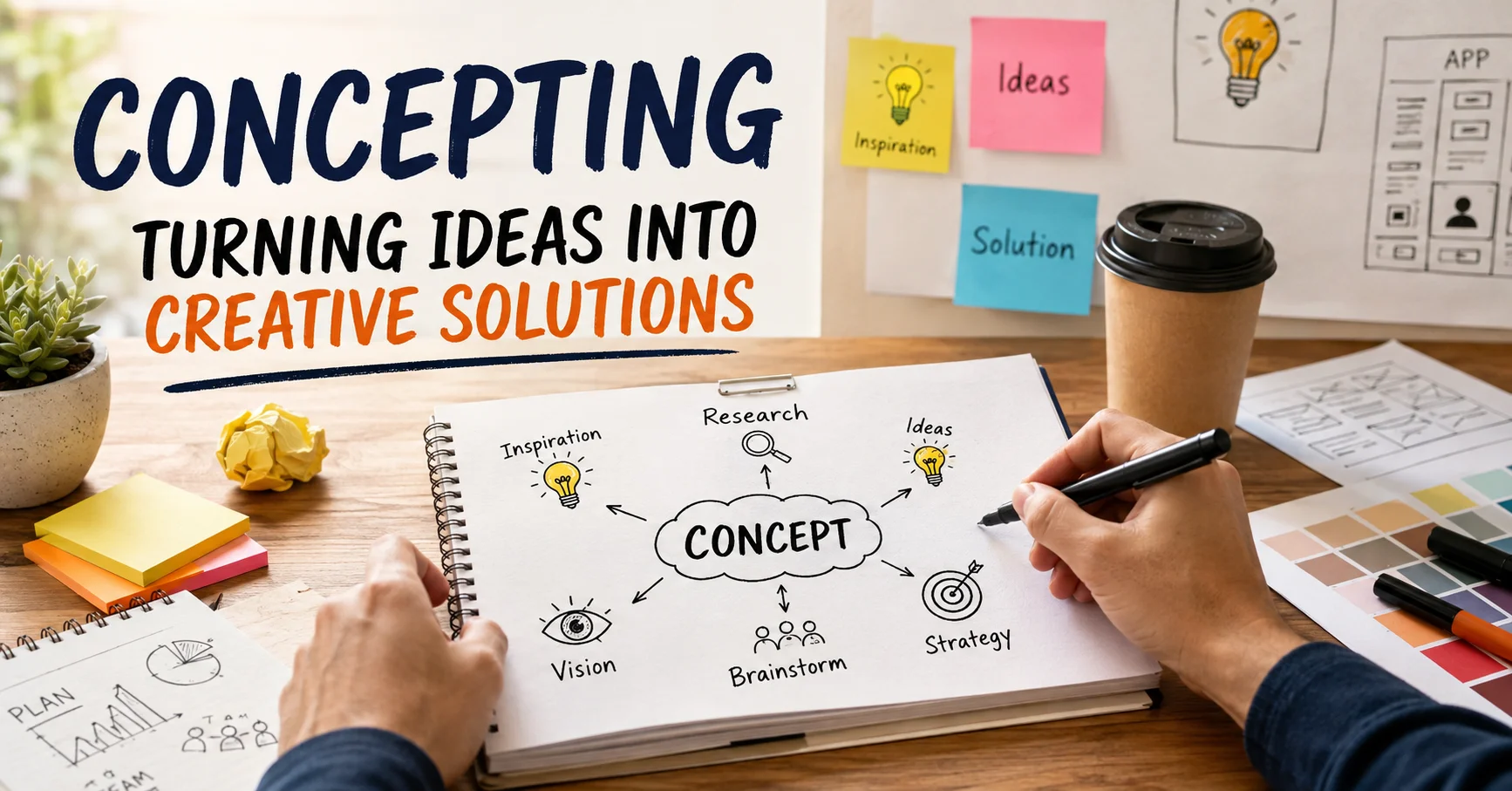
A great idea can appear in seconds. Turning that idea into something useful, memorable, and realistic takes much more work. This is where concepting comes in. Whether you are developing a marketing campaign, designing a product, planning a website, creating a brand identity, or solving a business problem, concepting helps transform a simple thought into a clear creative direction.
Think about the last time you had an idea that sounded brilliant in your head but became difficult to explain once you tried to put it into practice. That happens to everyone. An idea is only the beginning. Concepting gives that idea structure, purpose, and personality.
Good concepting is not about producing hundreds of random ideas. It is about exploring possibilities, understanding the problem, challenging assumptions, and finding a solution that connects creativity with real-world needs. When done well, it can make the difference between an ordinary project and one that people remember.
ALSO READ: Karmic Retribution: Understanding The Law Of Cause And Effect
What Is Concepting?
Concepting is the process of developing and shaping ideas into clear creative concepts that can eventually become products, campaigns, designs, experiences, or solutions.
It sits between imagination and execution. You may begin with a problem, a goal, a question, or even a vague thought. Through research, brainstorming, experimentation, discussion, and refinement, that initial thought becomes a concept that others can understand and act upon.
For example, imagine a company wants to make its packaging more environmentally friendly. Simply saying, “We should use sustainable packaging,” is an idea. Concepting takes that thought further.
The team might explore questions such as:
- What materials could be used?
- What would make the packaging easier to reuse?
- How can sustainability become part of the customer experience?
- What visual style would communicate the change?
- Can the new packaging reduce waste without increasing costs significantly?
The result might be a complete packaging concept with a defined material, appearance, message, customer experience, and practical purpose.
In simple terms, concepting gives an idea a direction.
Why Concepting Matters
Creative work can quickly become confusing when there is no clear direction. People may have different opinions about what should be created, who it is for, or what problem it should solve.
Concepting creates a shared foundation.
When everyone understands the central concept, designers, writers, marketers, developers, business owners, and other team members can work toward the same goal. Instead of making disconnected decisions, they can ask whether each decision supports the main idea.
Concepting also creates room for experimentation. Early in a project, changing an idea is usually easier and less expensive than changing a finished product.
A strong concept can help teams:
- Define the purpose of a project
- Generate better creative ideas
- Understand the target audience
- Explore different approaches
- Identify potential problems early
- Communicate ideas clearly
- Make design and content decisions easier
- Create a more consistent final result
Perhaps most importantly, concepting allows creativity to happen before practical limitations become too restrictive.
The Difference Between An Idea And A Concept
Ideas and concepts are closely related, but they are not the same thing.
An idea is often a possibility. A concept is a developed possibility with context and direction.
Consider a simple example: “Create a campaign about healthy eating.”
That is an idea.
A concept might be: “Show busy professionals how small food choices can create healthier daily routines through short, realistic stories featuring people making one simple change at a time.”
The second statement gives the creative team something to work with. It establishes an audience, a message, an approach, and a storytelling direction.
A useful concept often answers several basic questions:
What are we creating?
Who is it for?
What problem does it address?
Why does it matter?
What makes the approach interesting?
How could it work in practice?
The more clearly these questions can be answered, the stronger the concept becomes.
The Main Stages Of Concepting
Concepting does not always follow one strict formula. Different industries and creative teams use different methods. However, most successful concepting processes include several common stages.
Understand the Problem
Before generating ideas, understand what needs to be solved.
This sounds obvious, but it is one of the most frequently overlooked parts of creative work. People sometimes rush into brainstorming because generating ideas feels more exciting than analyzing the problem.
Start by asking what the actual challenge is.
Is the goal to increase awareness? Improve usability? Attract a new audience? Explain something complicated? Reduce costs? Make an experience more enjoyable?
A clear problem creates a useful boundary for creativity.
Without one, brainstorming can become a collection of unrelated ideas that sound interesting but do not solve anything.
Research the Context
Strong concepts rarely come from imagination alone.
Research provides the information needed to make creative thinking relevant. Depending on the project, research might involve studying competitors, customer behavior, industry trends, existing products, cultural patterns, customer reviews, or previous campaigns.
The goal is not to copy what already exists. Instead, research helps you understand the environment in which the concept will operate.
You may discover an unmet need, a frustrating customer experience, an overlooked audience, or an opportunity that competitors have ignored.
Sometimes the best concept comes from noticing something everyone else has overlooked.
Define the Audience
A creative concept becomes much stronger when you know exactly who it is intended for.
Different people respond to different messages, visuals, experiences, and solutions.
A concept designed for teenagers will probably communicate differently from one designed for corporate executives. A product intended for experienced professionals may need a different approach from one designed for beginners.
Go beyond basic demographic information when possible.
Ask:
- What does the audience care about?
- What frustrates them?
- What motivates them?
- What do they already know?
- What do they expect?
- What might prevent them from accepting the solution?
Understanding people makes creative work more human.
Generate Possibilities
Once the problem and audience are understood, it is time to explore possibilities.
This is where brainstorming becomes useful.
At this stage, quantity can be valuable. Do not immediately reject an unusual idea simply because it seems difficult. Some of the most interesting concepts emerge when people are allowed to explore unexpected connections.
Try different approaches:
- Write ideas quickly without judging them.
- Combine two unrelated ideas.
- Reverse the obvious solution.
- Ask what would happen if there were no traditional limitations.
- Look at the problem from the customer’s perspective.
- Explore the opposite of the expected approach.
- Use visual references to stimulate thinking.
- Build on someone else’s idea instead of starting over.
The purpose of early brainstorming is exploration, not perfection.
Find the Strongest Direction
Eventually, brainstorming needs to become more focused.
Review the ideas and look for concepts that have genuine potential.
A useful concept should ideally be relevant to the problem, meaningful to the audience, distinctive enough to stand out, and realistic enough to develop.
You might evaluate each idea by asking:
Does it solve the right problem?
Will the audience care about it?
Is it different enough to be noticed?
Can we explain it simply?
Can it realistically be created?
Does it support the larger goal?
This process helps separate exciting ideas from useful ones.
Develop the Concept
Once a direction has been selected, develop it further.
This is where a rough thought begins to become a complete creative concept.
You might create sketches, mood boards, sample copy, storyboards, prototypes, wireframes, visual references, customer journeys, or campaign examples.
The goal is to make the concept easier to see and understand.
A concept that sounds great but cannot be visualized or explained clearly may need additional development.
Test and Refine
A concept is not finished simply because the creative team likes it.
Testing provides an opportunity to discover weaknesses before significant resources are invested.
Depending on the project, testing might involve showing the concept to customers, gathering team feedback, creating a prototype, conducting usability testing, or comparing different creative directions.
Feedback should not automatically determine every decision. Instead, use it to identify confusion, weaknesses, and opportunities for improvement.
Then refine the concept.
Brainstorming Techniques That Improve Concepting
Brainstorming is one of the most familiar creative techniques, but simply sitting around a table and asking for ideas does not always produce great results.
Structured brainstorming can be much more effective.
Mind Mapping
Start with the central problem or idea and create branches containing related words, questions, emotions, experiences, and possibilities.
For example, a concept about travel might branch into adventure, relaxation, discovery, food, culture, memories, technology, convenience, and connection.
Those branches can lead to unexpected combinations.
SCAMPER
SCAMPER is another useful creative thinking method. It encourages people to examine an existing idea by asking whether they can Substitute, Combine, Adapt, Modify, Put to another use, Eliminate, or Reverse something.
This is particularly useful when improving an existing product or service rather than starting from scratch.
What If? Questions
“What if?” questions can remove mental barriers.
What if the customer never had to read instructions?
What if the product could be reused?
What if the campaign told the story from a different perspective?
What if the entire experience took half the time?
These questions encourage creative thinking beyond conventional solutions.
Forced Connections
Take two unrelated subjects and try to connect them.
For example, what could a coffee shop learn from a library? What could a mobile application learn from a physical notebook?
These comparisons can reveal new ways of thinking about familiar experiences.
The Role Of Creativity In Concepting
Creativity is central to concepting, but creativity does not mean being completely random.
Effective creative thinking involves making connections between existing information in new ways.
A concept can be creative because it combines familiar elements differently, tells a story from an unexpected perspective, simplifies a complicated process, or solves a common problem in an unusual way.
This is an important distinction.
You do not need to invent something that has never existed before to create a valuable concept. Sometimes the strongest creative solution is a familiar idea presented in a way that feels fresh and relevant.
Creativity works best when it has a purpose.
Concepting In Marketing
Marketing teams use concepting to develop campaign ideas, advertising themes, content strategies, brand messages, and customer experiences.
Imagine a company launching a new fitness product. The obvious marketing message might focus on features and specifications.
A stronger concept could focus on the emotional reality of starting a fitness routine: small wins, missed days, renewed motivation, and gradual progress.
The product remains important, but the concept gives the marketing campaign a story.
This is why concepting is so valuable in marketing. It helps transform a list of product features into a message people can connect with.
Concepting In Design
Designers use concepting to determine the visual and functional direction of a project.
Before choosing colors, fonts, layouts, materials, or shapes, designers often explore the broader idea behind the work.
A concept might be based on simplicity, movement, trust, energy, nostalgia, innovation, or naturalness.
Once that direction is established, design choices become easier.
Instead of asking, “Which color looks good?” the designer can ask, “Which color supports the concept?”
That small change in thinking can create much greater consistency.
Concepting In Product Development
Product teams also rely heavily on concepting.
A new product begins with a problem or opportunity. Teams then explore possible solutions before deciding what should actually be built.
Good product concepting considers both desirability and practicality.
A solution might be technically impressive but unnecessary. Another might solve a real problem but be too complicated for users.
Concepting helps teams explore these possibilities before committing significant time and money.
Prototypes can be especially useful during this stage because they allow people to interact with an early version of the idea.
Common Mistakes In Concepting
Even experienced creative teams can make mistakes during the concepting process.
Falling in Love With the First Idea
The first idea may be good, but it is rarely the only possible solution.
Exploring alternatives creates comparison and often reveals stronger directions.
Trying to Make Everyone Happy
A concept can become weak when too many opinions are added without a clear decision-making process.
Feedback matters, but the central objective should remain clear.
Ignoring the Audience
A creative idea that looks impressive to the team may not mean anything to the intended audience.
Always return to the people who will actually experience the final result.
Making the Concept Too Complicated
If a concept requires a long explanation before people understand it, it may need simplification.
Complex projects can have sophisticated thinking behind them while still being built around a simple central idea.
Confusing Novelty With Value
Something does not become valuable simply because it is unusual.
A concept should have a reason to exist. Creativity is most powerful when it creates meaning, usefulness, emotion, or improvement.
How To Make Concepting More Effective
Improving concepting is less about having a special talent and more about developing better habits.
Stay curious. Ask more questions. Pay attention to how people behave. Study things outside your industry. Keep notes about interesting observations. Give yourself permission to explore ideas that initially seem strange.
It also helps to separate creative exploration from evaluation.
If you judge every idea immediately, you may eliminate possibilities before they have a chance to develop.
Generate first. Evaluate later.
Another useful habit is learning to explain ideas simply. If you cannot describe the central concept in a few clear sentences, spend more time defining it.
A strong concept should be understandable without requiring an elaborate presentation.
When Should Concepting Begin?
Concepting should begin early, ideally before detailed execution starts.
Starting too late can create unnecessary limitations. If a team has already spent weeks designing, writing, coding, or producing materials, changing the central direction becomes much harder.
Early concepting provides room to explore.
It also saves resources because problems can be identified before they become expensive.
That does not mean the concept must remain unchanged throughout the project. Good creative work evolves. The important thing is to establish a meaningful direction early enough to guide the work.
Concepting Is A Process Not A Single Moment
One of the biggest misconceptions about creative work is that great concepts suddenly appear.
Sometimes they do.
More often, however, a strong concept develops gradually.
An observation leads to a question. The question leads to research. Research creates possibilities. Possibilities are tested, combined, rejected, and refined. Eventually, one direction begins to stand out.
That is concepting.
It is part strategy, part creativity, part research, and part problem-solving.
The process may look messy from the outside, but that exploration is often where the most valuable thinking happens.
The Future Of Concepting
As technology continues to change how people create, concepting remains important.
Modern creative tools can help generate images, text, prototypes, layouts, and other materials quickly. But having access to more tools does not automatically produce better ideas.
The human ability to understand context, recognize meaningful problems, empathize with people, make judgments, and connect ideas remains essential.
In fact, having more ways to produce content may make strong concepting even more valuable.
When almost anyone can create something quickly, the quality of the underlying idea becomes an important differentiator.
A thoughtful concept gives creative output a reason, direction, and identity.
Final Thoughts
Concepting is the bridge between imagination and execution. It takes a loose thought and asks an important question: “What could this become?”
The answer does not appear through brainstorming alone. Strong concepting requires curiosity, research, empathy, experimentation, critical thinking, and refinement.
Whether you are building a product, developing a campaign, creating a visual identity, improving a service, or solving a difficult problem, the process starts with understanding what needs to change and why.
The best concepts are not necessarily the loudest or most complicated. They are the ones that make sense, connect with people, solve a meaningful problem, and provide a clear path toward execution.
When you give ideas the time and structure they deserve, creativity becomes more than inspiration. It becomes a practical tool for turning possibilities into solutions.
FAQs
What is concepting?
Concepting is the creative process of developing an initial idea into a clear, purposeful, and workable concept or solution.
Why is concepting important?
Concepting helps teams explore possibilities, solve problems, clarify direction, and create stronger final products, campaigns, or experiences.
Is concepting the same as brainstorming?
No. Brainstorming is one technique used to generate ideas, while concepting involves developing, evaluating, and refining those ideas into a meaningful direction.
When should concepting begin?
Concepting should begin early in a project, before major execution decisions are made, so there is enough room to explore and refine different possibilities.
What makes a good concept?
A good concept is relevant, understandable, useful, distinctive, audience-focused, and realistic enough to develop into a final solution.
ALSO READ: Creative Writing Prompts Family Fun And Connection

Evelyn is a technology writer and researcher specializing in software development, artificial intelligence, and emerging digital systems. With hands-on experience in building and analyzing modern tech solutions, she focuses on translating complex technical concepts into clear, practical insights for developers, entrepreneurs, and curious readers.