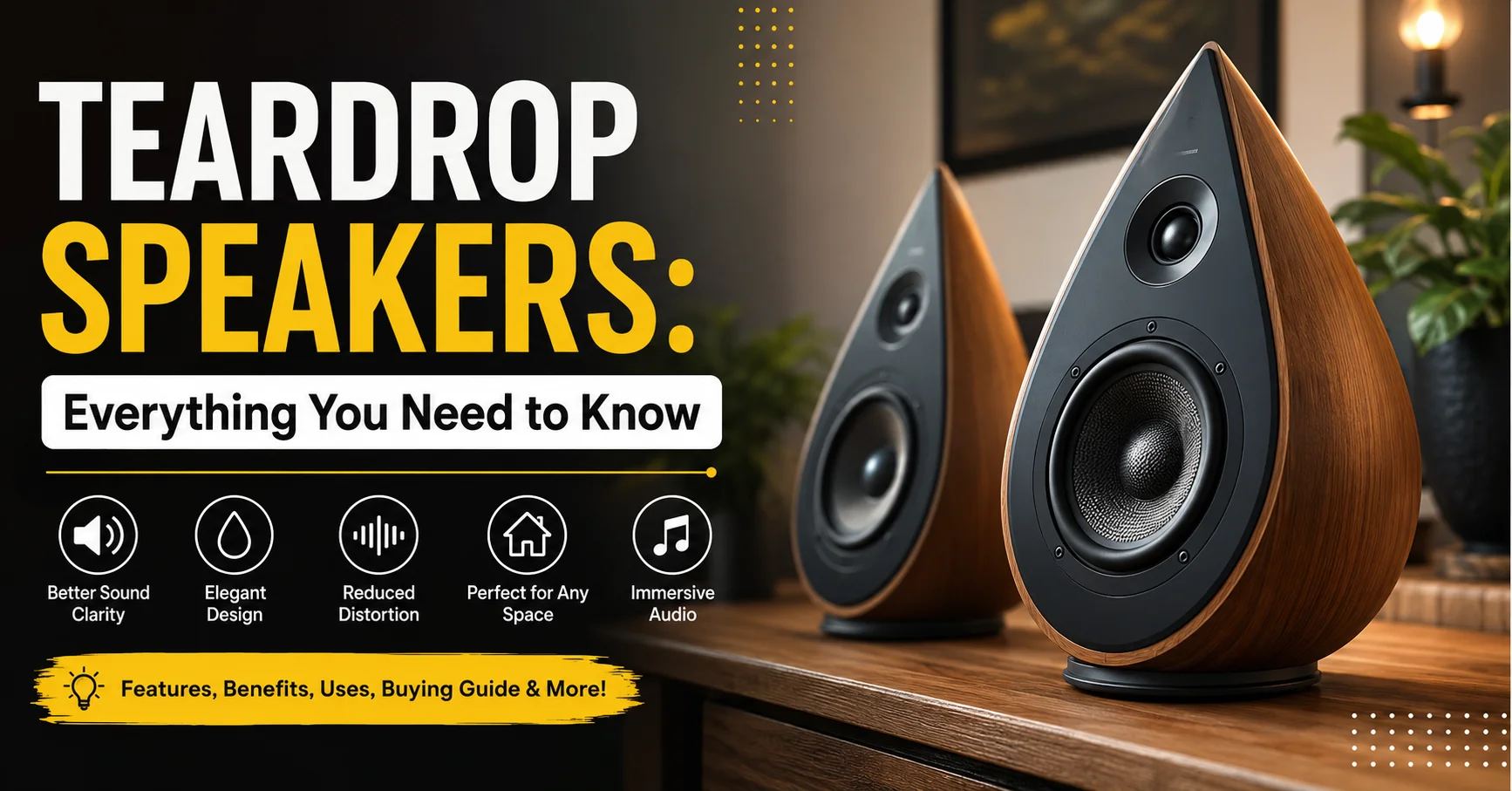
If you’ve been searching for speakers that combine unique aesthetics with impressive sound quality, you’ve probably come across teardrop speakers. Their eye-catching shape immediately stands out from traditional box speakers, but their appeal goes far beyond looks. Many audio enthusiasts appreciate teardrop because their distinctive design can help improve sound performance while adding a modern touch to any space.
Whether you’re setting up a home theater, upgrading your living room audio, or simply exploring different speaker designs, understanding how teardrop work can help you make a smarter buying decision.
you’ll learn what teardrop speakers are, how they work, their advantages and disadvantages, where they’re commonly used, what features to look for, and how to choose the right model for your needs.
ALSO READ: JVC NZ700 Review: Everything You Need To Know
What Are Teardrop Speakers?
Teardrop speakers are loudspeakers designed with a cabinet shaped like a teardrop instead of the traditional rectangular enclosure. This unique shape isn’t just for appearance—it can also contribute to better acoustic performance.
The rounded rear portion helps reduce unwanted internal sound reflections that often occur inside square speaker cabinets. This can produce cleaner audio with less distortion.
Teardrop speakers are available in various sizes and styles, including:
- Bookshelf speakers
- Floor-standing speakers
- Wireless Bluetooth speakers
- Portable speakers
- Home theater speakers
- Premium audiophile speakers
Their elegant design makes them popular among people who value both sound quality and interior aesthetics.
Why Are They Called Teardrop Speakers?
The name comes directly from their appearance.
Instead of having sharp corners and flat sides, these speakers feature:
- A rounded rear
- A narrow front
- Smooth curves throughout the enclosure
The shape closely resembles a water droplet or teardrop, giving the speakers their distinctive name.
Besides visual appeal, these curves can improve airflow around the cabinet and minimize sound wave interference inside the enclosure.
How Do Teardrop Speakers Work?
Like any conventional speaker, teardrop convert electrical signals into sound using several components.
These typically include:
Tweeter
The tweeter handles high-frequency sounds such as:
- Vocals
- Cymbals
- Strings
- High-pitched instruments
Quality tweeters produce crisp, detailed audio.
Midrange Driver
The midrange reproduces frequencies where most vocals and instruments exist.
A good midrange creates natural voices and balanced music.
Woofer
The woofer handles lower frequencies including:
- Bass guitars
- Drums
- Movie effects
Larger woofers generally deliver deeper bass.
Crossover
The crossover directs different frequency ranges to the appropriate drivers.
This allows every speaker component to focus on the sounds it reproduces best.
Cabinet
The cabinet plays a major role in sound quality.
In teardrop speakers, the curved enclosure helps reduce:
- Standing waves
- Cabinet resonance
- Internal reflections
- Audio coloration
The result can be cleaner, more accurate sound.
Advantages Of Teardrop Speakers
Many people choose teardrop speakers because they offer several benefits.
Improved Sound Clarity
The curved cabinet minimizes internal sound reflections.
This often produces:
- Cleaner vocals
- Better instrument separation
- Reduced distortion
- More accurate imaging
Attractive Design
One of the biggest selling points is appearance.
Teardrop speakers often look like decorative pieces rather than traditional electronics.
They fit well in:
- Modern homes
- Luxury apartments
- Offices
- Designer interiors
Better Acoustic Performance
Rounded enclosures help reduce cabinet resonance.
This allows the speaker drivers to perform more efficiently, resulting in clearer sound.
Wide Soundstage
Many premium teardrop speakers create an expansive stereo image.
Listeners often experience:
- Better left-right separation
- More immersive music
- Improved movie dialogue placement
Space-Saving Designs
Many teardrop speakers have compact footprints despite delivering impressive audio.
They’re suitable for:
- Small rooms
- Apartments
- Bedrooms
- Offices
Are Teardrop Speakers Better Than Traditional Speakers?
The answer depends on the specific speaker model rather than the shape alone.
A well-designed traditional speaker can outperform a poorly built teardrop speaker.
However, premium teardrop speakers often offer advantages such as:
- Reduced cabinet resonance
- Improved internal acoustics
- Elegant appearance
- Better sound dispersion
Ultimately, driver quality, crossover design, amplifier matching, and cabinet construction all play larger roles than shape alone.
Common Uses Of Teardrop Speakers
Teardrop speakers work well in many situations.
Home Audio Systems
Many homeowners use them for:
- Music listening
- Streaming services
- Vinyl records
- Everyday entertainment
Home Theater
High-quality teardrop speakers create immersive surround sound for movies and gaming.
Office Audio
Their stylish design blends easily into professional workspaces.
They provide pleasant background music without looking bulky.
Luxury Interior Design
Interior designers frequently choose teardrop speakers because they complement contemporary furniture.
Audiophile Listening Rooms
Many premium brands manufacture teardrop-style speakers aimed at serious music enthusiasts seeking accurate sound reproduction.
Features To Look For When Buying Teardrop Speakers
Before making a purchase, consider these important features.
Driver Size
Larger drivers generally provide:
- Stronger bass
- Higher volume
- Better dynamic range
Smaller drivers work well in compact rooms.
Frequency Response
A wider frequency response usually means the speaker can reproduce more detail across the audio spectrum.
Sensitivity Rating
Higher sensitivity means the speaker can produce louder sound with less amplifier power.
Power Handling
Make sure the speaker matches your amplifier’s output.
This helps prevent distortion or damage.
Build Quality
Look for cabinets made from:
- MDF
- High-density composite materials
- Aluminum
- Premium wood
Solid construction minimizes unwanted vibrations.
Connectivity
Depending on the model, you may find:
- Wired inputs
- Bluetooth
- Wi-Fi
- Optical inputs
- HDMI ARC
- USB
Choose the connectivity options that fit your setup.
Passive vs Active Teardrop Speakers
There are two main categories.
Passive Speakers
Passive speakers require an external amplifier.
Advantages include:
- Greater customization
- Higher upgrade potential
- Better compatibility with hi-fi systems
Active Speakers
Active speakers have built-in amplifiers.
Benefits include:
- Easy setup
- Fewer cables
- Compact design
- Plug-and-play convenience
Choosing The Right Size
The size of your room matters.
Small Rooms
Choose compact bookshelf teardrop speakers.
They provide excellent clarity without overwhelming the space.
Medium Rooms
Mid-sized floor speakers deliver balanced sound across the room.
Large Rooms
Large floor-standing models offer:
- Greater output
- Fuller bass
- Wider soundstage
They perform better in open living areas.
Placement Tips For Better Sound
Even excellent speakers perform poorly if placed incorrectly.
For best results:
- Position speakers at ear level.
- Leave some distance from walls.
- Avoid placing speakers inside enclosed cabinets.
- Angle them slightly toward the listening position.
- Keep left and right speakers evenly spaced.
- Reduce obstacles between speakers and listeners.
Proper placement can dramatically improve sound quality.
Do Teardrop Speakers Produce Better Bass?
Not necessarily.
Bass performance depends on several factors:
- Woofer size
- Cabinet volume
- Port design
- Amplifier power
- Speaker tuning
Some compact teardrop speakers prioritize clarity over deep bass.
If powerful low frequencies are important, consider pairing the speakers with a quality subwoofer.
Maintenance Tips
Keeping your speakers in good condition extends their lifespan.
Helpful maintenance includes:
- Dust the cabinet regularly.
- Clean speaker grills gently.
- Avoid excessive moisture.
- Protect from direct sunlight.
- Keep liquids away.
- Use proper cables.
- Avoid maximum volume for extended periods.
Routine care helps maintain both appearance and performance.
Common Misconceptions About Teardrop Speakers
They Only Look Good
While appearance is a major attraction, many models are engineered for impressive acoustic performance.
They Are Only for Luxury Homes
Today, teardrop speakers are available across many price ranges, making them accessible to more buyers.
Every Teardrop Speaker Sounds Better
The cabinet shape alone doesn’t guarantee superior sound.
Driver quality, crossover engineering, materials, and tuning remain the biggest factors.
They’re Difficult to Install
Most active models require only a simple power connection and Bluetooth pairing, while passive models connect like standard speakers.
Are Teardrop Speakers Worth Buying?
If you appreciate modern design and high-quality audio, teardrop speakers can be an excellent investment.
They’re especially suitable for people who want speakers that complement their home’s décor while delivering enjoyable listening experiences.
For casual listeners, they provide attractive styling and solid performance.
For audio enthusiasts, premium models can offer refined sound with excellent imaging and reduced cabinet resonance.
The best choice ultimately depends on your room size, listening habits, budget, and preferred features.
Conclusion
Teardrop speakers offer a refreshing alternative to traditional speaker designs. Their elegant curved cabinets aren’t just visually appealing—they can also help reduce internal sound reflections and improve overall audio clarity. Whether you’re building a home theater, upgrading your music system, or simply looking for speakers that blend beautifully with modern interiors, teardrop speakers provide a combination of style and performance that’s hard to ignore.
As with any audio equipment, the best results come from choosing quality components, matching them with the right amplifier or source, and placing them correctly within your room. By understanding the features, benefits, and considerations discussed in this guide, you’ll be well prepared to select the right teardrop speakers for your listening needs.
FAQs
What is a teardrop speaker?
A teardrop speaker is a loudspeaker with a curved, teardrop-shaped cabinet designed to improve aesthetics and potentially enhance acoustic performance by reducing internal sound reflections.
Are teardrop speakers good for home theaters?
Yes. Many teardrop speakers provide excellent clarity, imaging, and immersive sound, making them suitable for home theater systems.
Do teardrop speakers need an amplifier?
Passive teardrop speakers require an external amplifier, while active models have built-in amplifiers and work independently.
Can teardrop speakers connect wirelessly?
Many modern teardrop speakers include Bluetooth or Wi-Fi connectivity for convenient wireless audio streaming.
Are teardrop speakers worth the price?
For many buyers, they are worth considering because they combine stylish design with strong audio performance, especially when built with high-quality drivers and well-engineered cabinets.
ALSO READ: Do Dashcams Record Audio And Is It Legal?

Evelyn is a technology writer and researcher specializing in software development, artificial intelligence, and emerging digital systems. With hands-on experience in building and analyzing modern tech solutions, she focuses on translating complex technical concepts into clear, practical insights for developers, entrepreneurs, and curious readers.